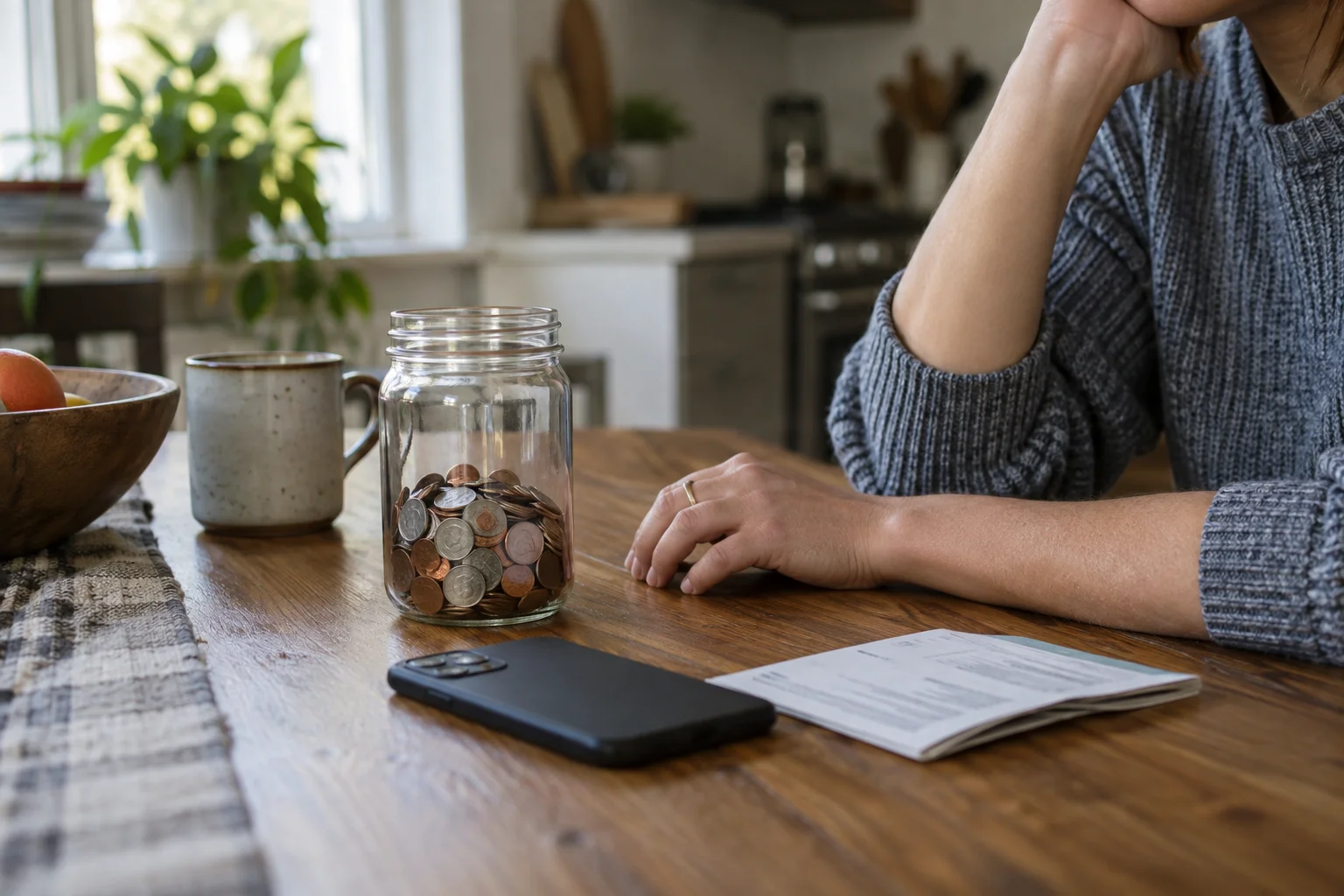
Round-up apps feel like magic. Every time you buy a coffee, the app rounds the charge up to the next dollar and sweeps the difference into savings. You barely notice, and a few months later there’s a couple hundred dollars you didn’t know you had. It’s a good feeling, and the apps are not a scam. But they’re also not a savings plan, and treating them like one is how a lot of people convince themselves they’re saving when they’re really just collecting crumbs. Here’s what round-ups actually do, why they fall short, and the simple rule that outperforms them without any more effort.
Do the math on what round-ups really add up to
The average round-up is about fifty cents. If you make forty card transactions a month, which is a fairly active spender, that’s around twenty dollars saved. Over a year, it’s a bit over two hundred. That’s not nothing, and for someone who has never saved a dollar, it’s a genuine start. But it’s also a rounding error against most real goals. A modest emergency fund, a car repair, a security deposit, or a decent vacation all sit well beyond what spare change will ever reach. If your only savings mechanism is round-ups, you’re on a path that feels like progress but never arrives anywhere.
The hidden problem: they reward spending
There’s a subtler issue. Round-ups only happen when you buy something. The more transactions you make, the more you “save,” which quietly ties your savings to your spending. On a month when you rein in purchases, your savings drop. That’s exactly backward. A healthy savings habit should be strongest in the months you spend least, not weakest. Some apps let you add multipliers or recurring deposits, and that helps, but at that point you’re no longer really saving spare change; you’re just running a normal automatic transfer through an app that takes a fee.
Watch the fees
Many round-up services charge a flat monthly fee. On a small balance, a few dollars a month can be a significant percentage of what you’ve saved, and in the early months it can exceed any interest or growth you’d earn. Look at what you’re paying, look at what you’ve accumulated, and ask whether a free savings account with an automatic transfer would leave you with more. It usually would.
The percentage rule
Here’s what beats round-ups every time: pick a percentage of every deposit that goes to savings before you do anything else, and automate it. Not a dollar amount, a percentage. Ten percent is the classic starting point, and if that’s too much right now, start at five and raise it by one point every couple of months. The moment your paycheck lands, that slice moves to a separate savings account, ideally at a different bank so it takes a day to get back.
Why a percentage instead of a fixed amount? Because it scales with your life without you having to remember to change it. A raise automatically raises your savings. A bonus automatically saves a slice. A lean month saves a smaller slice instead of forcing you to skip. And because it’s tied to income instead of spending, your savings are healthiest in exactly the months you’re most careful.
Set it up in fifteen minutes
You have two easy paths. If your employer offers split direct deposit, set the percentage there, so the savings portion never even passes through your checking account. If not, set an automatic transfer at your bank for the day after each payday. Some banks let you set the transfer as a percentage of a deposit; if yours doesn’t, calculate the dollar amount from your typical check and revisit it when your pay changes.
Name the savings account for its purpose. “Emergency fund” or “House deposit” holds up far better against the urge to raid it than “Savings.”
Keep the round-ups if you like them, but demote them
There’s no harm in keeping a round-up app running as a small bonus on top of a real plan, especially if it’s free. Just be clear with yourself about what it is: a garnish, not the meal. The percentage transfer is your savings plan. The round-ups are pocket change. If the app charges a fee, the honest move is usually to cancel it and roll that fee into your percentage.
Where the percentage takes you
Ten percent of a $3,000 monthly take-home is $300 a month, or $3,600 a year, before any interest. That’s a real emergency fund in a year, which round-ups couldn’t reach in a decade. Bump the percentage a point at a time and the number grows faster than feels possible. The habit is identical in effort to the app: set it once, forget it. The only difference is that this one actually gets you somewhere.