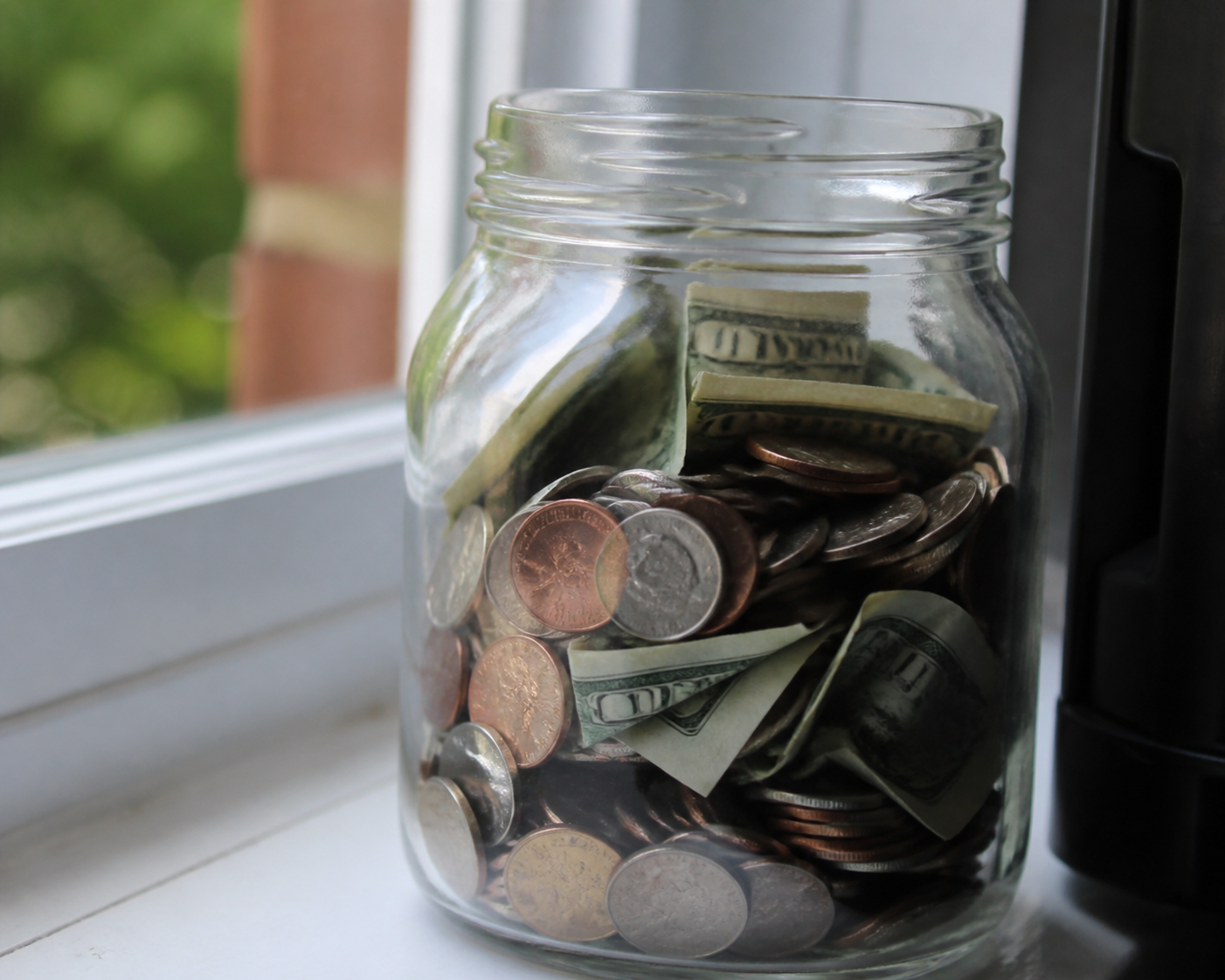
Big savings goals fail for a predictable reason: they feel too large to start. “Save $6,000 for an emergency fund” is intimidating enough that a lot of people never open the savings account in the first place. Shrinking the target to something almost silly — $5 a day — removes that barrier entirely, and the math works out better than most people expect.
The actual math behind the habit
Five dollars a day, moved automatically into a separate savings account, adds up to $1,825 over 365 days. That’s before any interest. Park that money in a high-yield savings account currently paying around 4-4.5% APY, and you’ll pick up an extra $35-45 over the year just from interest, pushing you closer to $1,860-$1,870. It’s not going to replace a six-month emergency fund on its own, but it builds the single most important thing a lot of budgets are missing: a buffer between you and a $400 unexpected expense, which is the exact size of emergency that derails the most households.
Why $5 works when $150 a month doesn’t
Framing matters more than people give it credit for. “$150 a month” sounds like a line item that competes with rent and groceries for space in your brain. “$5 a day” sounds like a coffee you skipped, a couponed grocery trip, a round-up from a purchase. Behaviorally, people are far more willing to commit to small, frequent actions than to large, infrequent ones, even when the totals are identical. This is the same psychological principle that makes daily flossing easier to stick with than a twice-a-year dentist deep-clean — frequency lowers the perceived cost per action.
Automating it so willpower is never the mechanism
The version of this habit that actually survives a busy year is automatic, not manual. Set up a recurring daily or weekly transfer — $5 daily or $35 weekly, same result — from checking to a separate savings account, timed for the day after payday clears. Most banks and credit unions support this without any fee. The point of automation isn’t convenience; it’s removing the daily decision entirely. A habit you have to remember to do gets skipped during a hard week. A habit that happens without your input survives the hard weeks precisely when you need the fund to be growing.
Where to actually find the $5
If your budget genuinely has zero slack, $5 a day can still usually be found without touching anything essential. Brewing coffee at home instead of buying it saves $3-5 per cup on average. Switching one takeout meal a week to a home-cooked one saves $10-15 easily, which covers two or three days on its own. Auditing a single unused subscription often finds $10-15 a month by itself. The goal isn’t to find all $5 from one source — it’s to notice that $5 a day is genuinely small enough to assemble from the cracks in most budgets without a dramatic lifestyle change.
What the habit looks like across a full calendar year
It helps to see the trajectory instead of just the final number. By day 30, the account holds about $150 — enough to cover a car battery or a vet visit co-pay. By day 90, roughly $450, which starts to look like a real cushion against a $400 average unexpected expense. By day 180, around $900, and by day 270, about $1,350. The growth is perfectly linear, which is actually the point: there’s no dramatic acceleration to wait for and no plateau to push through, just the same $5 landing in the account every single day regardless of how the rest of your month is going. Watching those milestones pass — $150, $450, $900 — tends to do more for motivation than the eventual $1,825 total, because each one arrives quickly enough to feel like proof the system is working, not a distant promise.
What to do once you hit the first $500
Momentum matters here. Once the account crosses a real milestone — $500 covers most car repairs and appliance breakdowns — resist the urge to either stop or dramatically increase the daily amount. Instead, keep the $5 flowing and treat the account as genuinely off-limits except for true emergencies: job loss, medical bills, essential car or home repairs. Write the rule down somewhere you’ll see it. The temptation to dip into a growing balance for a vacation or a sale is strongest right when the account starts to feel substantial, which is exactly the point it’s finally doing its actual job.
Scaling it up once the habit is proven
After a full year of consistent $5-a-day saving, you’ll have direct evidence that the habit sticks — which is worth more than any spreadsheet projection. At that point, many people find it easy to bump the daily amount to $7 or $10 without feeling it, because the account itself has become a fixture rather than a new, fragile habit. That’s how a $1,800 starter fund becomes a genuine 3-6 month emergency cushion over two or three years, built almost entirely on autopilot.